



The VRT Advantage.
A More Efficient Way to Muscle Growth in 2026
Why settle for static weight when your strength isn't static? Variable Resistance Training (VRT) is the evolution of hypertrophy, designed to match the natural strength curve of the human body.
The Science of the Curve
In a traditional lift, you are limited by your "sticking point"—the weakest part of the movement. VRT changes the game by increasing resistance as you move into your strongest range, ensuring your muscles are fully challenged from start to finish.
In the pursuit of muscle growth and peak physical performance, the fitness world has long been dominated by a simple, unwavering principle: add more weight. For decades, the image of progress has been synonymous with loading another iron plate onto a barbell. This method, known as traditional constant resistance training, has built countless physiques and shattered numerous records. However, as our understanding of biomechanics deepens, a critical flaw in this approach has come to light. The human body does not operate with the consistency of a machine, and treating it as such leads to suboptimal results and unnecessary strain. Enter Variable Resistance Training (VRT), a sophisticated methodology that aligns external load with the body's natural mechanics, offering a more intelligent, efficient, and safer path to muscle growth.
The Biomechanical Mismatch: Why Constant Resistance Falls Short
To understand the revolutionary nature of VRT, one must first grasp the concept of the "strength curve." Every multi-joint exercise you perform, from a bench press to a squat, has a unique strength curve—a graphical representation of the amount of force your muscles can produce throughout the full range of motion.
Take the bench press as a prime example. At the bottom of the movement, with the bar resting on your chest, your pectoral and deltoid muscles are in a mechanically disadvantaged, stretched position. This is your "sticking point," the weakest link in the chain. The maximum weight you can lift is determined by what you can handle at this specific, vulnerable angle. However, as you press the bar upward, your leverage improves dramatically. By the time you reach the top of the movement with your arms fully extended, your muscles are in a position of peak mechanical advantage. The weight that was a maximal challenge at the bottom now feels significantly lighter, providing minimal stimulus for growth.
This phenomenon creates what experts call "resistance mismatch." The constant load of a barbell only truly challenges your muscles for a small fraction of the movement—the weakest part. For the rest of the repetition, where your muscles are capable of producing far more force, the stimulus is inadequate. You are, in essence, undertraining your muscles for the majority of the exercise's range. This not only limits potential growth but also concentrates immense stress on the joints at their most vulnerable angles, increasing the risk of injury.
The VRT Revolution: Matching Force with Force
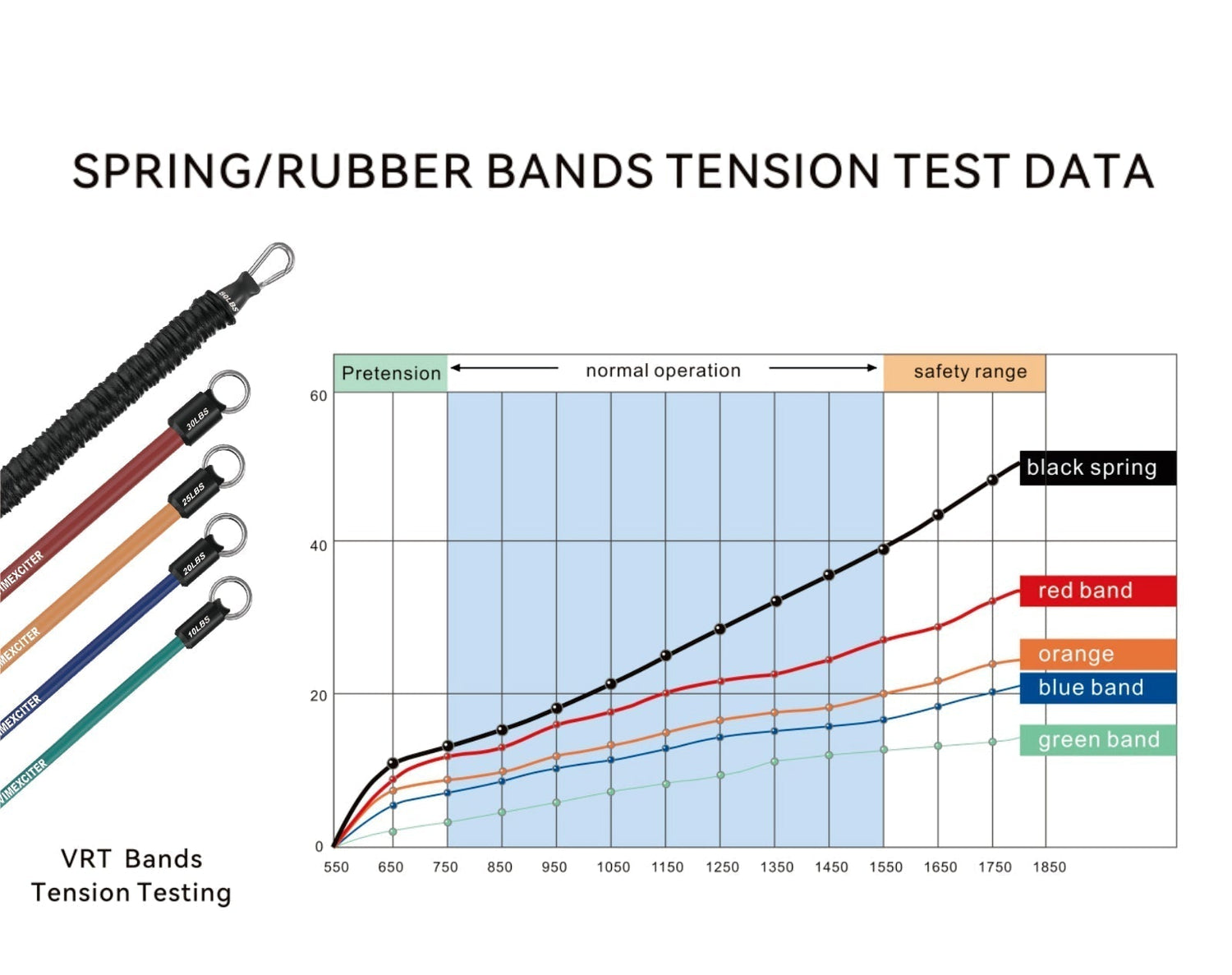
Variable Resistance Training elegantly solves this biomechanical puzzle. The core principle of VRT is to dynamically alter the external resistance to match your body's fluctuating strength curve. The goal is simple yet profound: to provide maximum resistance precisely when your muscles are at their strongest, and minimum resistance when they are at their weakest.
This is achieved through various tools, most commonly elastic bands or chains attached to a barbell, or through advanced motorized machines. As you move through an exercise, the resistance changes. In a banded squat, for instance, the bands are slack at the bottom of the squat, providing minimal assistance and keeping the load manageable. As you stand up and the bands stretch, the resistance increases, peaking at the top of the movement where your quadriceps and glutes are most powerful.
This "dynamic matching" ensures that your target muscles are under a high level of tension throughout the entire repetition. There is no "coasting" at the top. This sustained, peak tension is the primary driver of muscle hypertrophy, or growth. By forcing the muscle to work at its maximum capacity for a longer duration, VRT creates a more potent stimulus for adaptation, leading to more efficient and comprehensive muscle development.
The Science of Efficiency: More Growth, Less Grind
The superiority of VRT is not just theoretical; it is backed by a growing body of scientific evidence. Research has consistently shown that VRT can lead to greater strength and power gains compared to traditional training methods. A key reason for this is enhanced neuromuscular adaptation.
Because the resistance is constantly changing, your central nervous system is forced to work overtime. Your brain must continuously adjust the recruitment and firing rate of motor units—the nerve cells that activate muscle fibers—to control the movement. This heightened neural demand leads to more efficient communication between your brain and muscles, allowing you to generate more force. Studies on athletes, such as basketball players and taekwondo practitioners, have demonstrated that VRT can produce significant improvements in vertical jump height and explosive power, attributes directly tied to neural efficiency and rate of force development.
Furthermore, VRT promotes a more complete type of muscle growth. Traditional training often leads to a disproportionate increase in muscle size versus strength, sometimes resulting in what is colloquially called "dead muscle"—muscle that looks large but lacks functional power. This is because constant resistance can stimulate sarcoplasmic hypertrophy, an increase in the non-contractile fluid within the muscle cell. VRT, by contrast, with its emphasis on peak tension and acceleration, favors myofibrillar hypertrophy—the growth of the actual contractile proteins (actin and myosin) responsible for generating force. The result is not just bigger muscles, but denser, stronger, and more "functional" muscles that are better equipped to handle real-world demands.
Joint Preservation and Longevity: A Smarter Approach
For anyone invested in long-term fitness, joint health is paramount. The conventional approach of constantly adding weight to a barbell places immense and often damaging stress on connective tissues, particularly at the weak points of an exercise. This cumulative stress is a primary cause of the chronic injuries that plague serious lifters.
VRT offers a protective mechanism. By reducing the load at the most vulnerable joint angles, it significantly decreases shear force on ligaments and compression on cartilage. In a squat, the knees and lower back are under the most stress at the bottom of the movement. With VRT, the resistance is lightest at this exact point, allowing for a safer, more controlled descent. As you move into a stronger position, the load increases, challenging the muscles without compromising the joints.
This makes VRT an exceptionally smart strategy for athletes, older adults, or anyone recovering from an injury. It allows for the development of strength and muscle mass without the high risk of wear and tear. It shifts the focus from "how much can I lift?" to "how effectively can I stimulate my muscles?" This paradigm change is crucial for sustainable progress, ensuring that your fitness journey is measured in decades, not years.
Implementing VRT: Practical Applications for Growth
Integrating Variable Resistance Training into your routine is straightforward and can be applied to all major compound movements.
- For the Gym-Goer: The simplest way to start is by adding elastic bands or chains to your barbell squats, bench presses, and deadlifts. Start with a lighter band tension to get accustomed to the feeling of accelerating through the entire movement. The goal is to maintain control while fighting the increasing resistance.
- For the Home Athlete: Modern VRT machines and cable systems with variable cams are designed to replicate this strength curve automatically. These tools offer a seamless and highly effective way to experience the benefits of VRT without the complexity of setting up bands and chains.
- Programming Principles: You can use VRT as a primary strength movement or as an accessory exercise. A common approach is to perform your main lift with a barbell for heavy, low-rep sets, and then use VRT for higher-rep, hypertrophy-focused sets to fully fatigue the muscle.
Why VRT is More Efficient:
-
Vimexciter: Bringing VRT Technology into Your Home Fitness Space
Our smart motor system changes the resistance in real-time to match your strength. It gives you lighter resistance where your joints are under the most stress and maximum resistance where you are strongest. This protects your joints and makes sure your muscles are working hard through the entire exercise.This constant muscle activation also helps you burn fat faster. Compared to regular weights, the VRT mode on Vimexciter works more muscles in less time, creating a stronger "afterburn effect" (EPOC) so you keep burning calories after your workout. Vimexciter is more than a machine; it's your smart partner for building a stronger, leaner, and injury-free body.
Experience the Future of Training
Our VRT-powered Smith machines and cable systems are engineered for peak efficiency.
Shop VRT Technology


Leave a comment
This site is protected by hCaptcha and the hCaptcha Privacy Policy and Terms of Service apply.